Breweries & distilleries
Breweries & distilleries
Odoo for breweries and distilleries
From raw material and recipe to batch, excise duty, webshop, and accounting all in one system
A brewery or distillery is no ordinary production environment.
Raw materials are processed into intermediate products. Products ferment, age, distill, blend, dilute, bottle, and package. Throughout this process, quantities, volumes, alcohol percentages, locations, and tax statuses change.
At the same time, production, food safety, inventory, excise duties, sales, delivery, invoicing, and online sales must remain aligned with one another.
Newconomie sets up Odoo as a central business platform for breweries, distilleries, and other producers of alcoholic beverages. Not as a standalone administrative package, but as a system where your entire business operations are logically connected.
One environment for:
● Purchasing and raw materials
● Recipes and production planning
● Brewing, fermenting, distilling, and aging
● Tanks, barrels, IBCs, and storage locations
● Batches, lot numbers, and traceability
● Quality controls and HACCP or APPCC
● Excise registrations and fiscal inventory
● Bottling, labeling, and packaging
● B2B sales, consumer sales, and private label
● Websites and webshops
● Inventory, logistics, and delivery
● Invoicing, accounting, and reporting
Fewer separate files. Less reconstruction work. More control over what is actually happening in the company
Odoo for breweries and distilleries
From raw material and recipe to batch, excise duty, webshop, and accounting all in one system
A brewery or distillery is no ordinary production environment.
Raw materials are processed into intermediate products. Products ferment, age, distill, blend, dilute, bottle, and package. Throughout this process, quantities, volumes, alcohol percentages, locations, and tax statuses change.
At the same time, production, food safety, inventory, excise duties, sales, delivery, invoicing, and online sales must remain aligned with one another.
Newconomie sets up Odoo as a central business platform for breweries, distilleries, and other producers of alcoholic beverages. Not as a standalone administrative package, but as a system where your entire business operations are logically connected.
One environment for:
● Purchasing and raw materials
● Recipes and production planning
● Brewing, fermenting, distilling, and aging
● Tanks, barrels, IBCs, and storage locations
● Batches, lot numbers, and traceability
● Quality controls and HACCP or APPCC
● Excise registrations and fiscal inventory
● Bottling, labeling, and packaging
● B2B sales, consumer sales, and private label
● Websites and webshops
● Inventory, logistics, and delivery
● Invoicing, accounting, and reporting
Fewer separate files. Less reconstruction work. More control over what is actually happening in the company
- Recipes and production steps are in different files.
- Actual consumption deviates from the planned amount.
- Raw materials, semi-finished products, and finished products are administratively mixed up.
- Not everyone knows which batch is in which tank or barrel.
- Losses during production or storage are only discovered afterwards.
- Quality controls are not directly linked to a production order.
- Excise data must be collected afterwards from various sources.
- Webshop, sales, and production work with different inventory levels.
- It is difficult to determine the actual cost price of a batch.
- Information for an inspection or recall is not directly available.
Odoo brings this data together. This creates one digital line from supplier and raw material to production, storage, sales, and customer.
Craft production requires professional control
Brewing beer and distilling spirits remain artisanal processes. But as a
company grows, the administration behind that craft becomes increasingly important.
A recipe in a spreadsheet, production notes on paper, and inventory levels in different
systems may still work for a few productions per month. With more products, sales channels,
employees, or locations, differences quickly arise.
Recognizable problems include:
- Recipes and production steps are in different files.
Recognizable problems include:
- Recipes and production steps are in different files.
- Actual consumption deviates from the planned amount.
- Raw materials, semi-finished products, and finished products are administratively mixed up.
- Not everyone knows which batch is in which tank or barrel.
- Losses during production or storage are only discovered afterwards.
- Quality controls are not directly linked to a production order.
- Excise data must be collected afterwards from various sources.
- Webshop, sales, and production work with different inventory levels.
- It is difficult to determine the actual cost price of a batch.
- Information for an inspection or recall is not directly available.
Odoo brings this data together. This creates one digital line from supplier and raw material to production, storage, sales, and customer.
Craft production requires professional control
Brewing beer and distilling spirits remain craft processes. But as soon as a
business grows, the administration behind that craft becomes increasingly important.
A recipe in a spreadsheet, production notes on paper, and inventory levels in different
systems may still work for a few productions per month. With more products, sales channels,
employees, or locations, differences quickly arise.
The complete production in Odoo
Recipes as the basis of every production
A reliable production starts with a clear recipe.
In Odoo, raw materials, packaging, quantities, production steps, and operations can be
recorded in bills of materials and production processes. This way, the system knows what is needed to produce a specific
beer, distillate, or other beverage product.
The complete production in Odoo
Recipes as the basis of every production
A reliable production starts with a clear recipe.
In Odoo, raw materials, packaging, quantities, production steps, and operations can be
recorded in bills of materials and production processes. This way, the system knows what is needed to produce a specific
beer, distillate, or other beverage product.
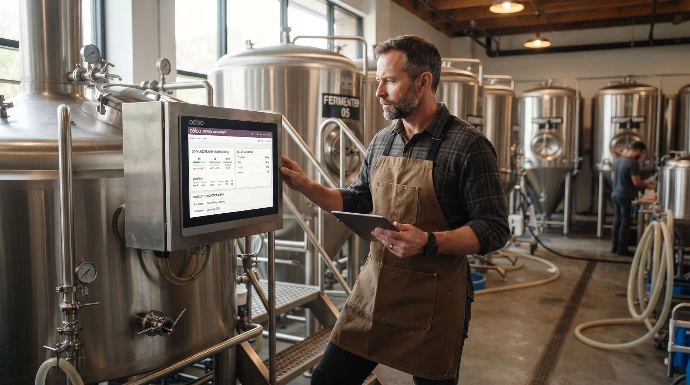
For a brewery, a process can consist of:
- Reserving raw materials.
- Packaging.
- Milling.
- Mashing.
- Filtering.
- Boiling.
- Cooling.
- Fermenting.
- Aging.
- Possibly filtering or blending.
- Filling.
- Labeling.
For a brewery, a process can consist of:
- Reserving raw materials.
- Packaging.
- Milling.
- Mashing.
- Filtering.
- Boiling.
- Cooling.
- Fermenting.
- Aging.
- Possibly filtering or blending.
- Filling.
- Labeling.
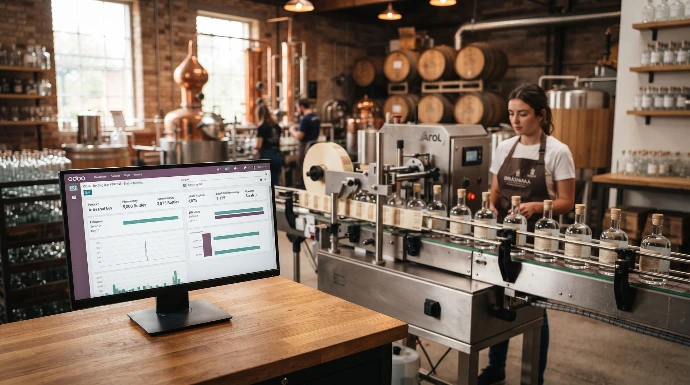
In a distillery, the chain can consist of:
- Receiving or producing the base liquid.
- Packaging.
- Maceration or preparation.
- Distillation.
- Separation of fractions.
- Storage in tank, barrel, or IBC.
- Aging.
- Blending.
- Dilution.
- Resting time.
- Bottling.
- Labeling.
Production orders and work orders
Every production can be started from a production order. It specifies:
- Which product is being produced.
- Which recipe is used.
- Which quantity is planned.
- Which raw materials are reserved.
- Which production steps need to be performed.
- Who is responsible.
- When the production is scheduled.
- What has actually been consumed.
- How much product has actually been obtained.
- Which batch or lot numbers have been generated.
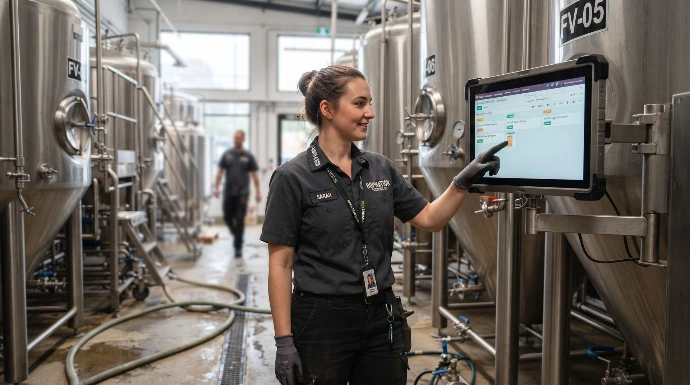
Employees can register progress from the shop floor. This creates a current picture of productions that are planned, started, blocked, or completed.
Production orders and work orders
Every production can be started from a production order. It specifies:
- Which product is being produced.
- Which recipe is used.
- Which quantity is planned.
- Which raw materials are reserved.
- Which production steps need to be performed.
- Who is responsible.
- When the production is scheduled.
- What has actually been consumed.
- How much product has actually been obtained.
- Which batch or lot numbers have been generated.
Employees can register progress from the shop floor. This creates a current picture of productions that are planned, started, blocked, or completed.
Recipe Versions and product development
Recipes change. An ingredient is replaced, an alcohol percentage is adjusted, or a different bottle and closure is used.
Without version control, it is difficult to determine later which composition was used for a specific batch.
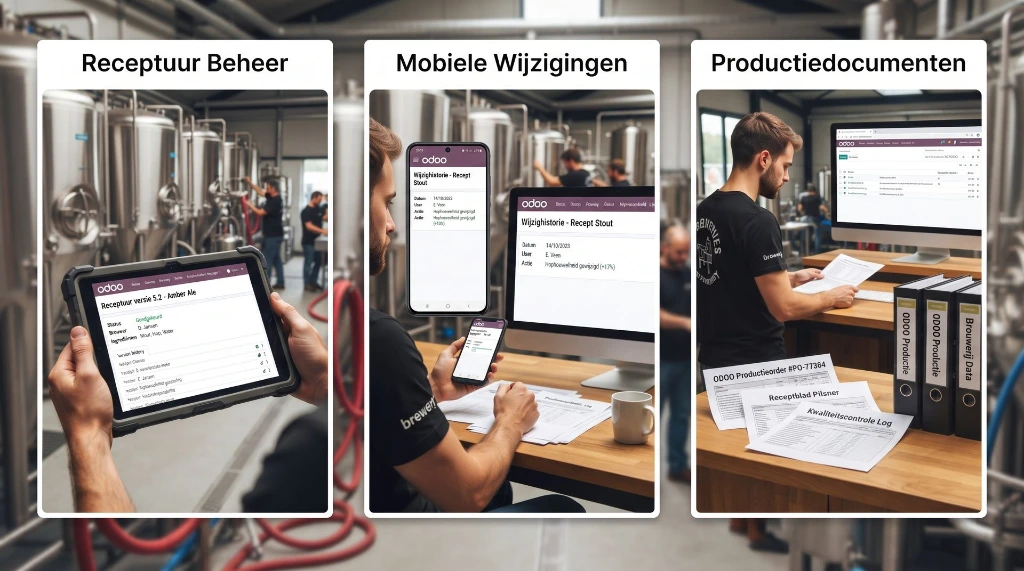
Newconomie can organize the process so that changes are implemented in a controlled manner. This can include recipe versions, documents, approvals, text productions, and change history being recorded.
Recipe Versions and product development
Recipes change. An ingredient is replaced, an alcohol percentage is adjusted, or a different bottle and closure is used.
Without version control, it is difficult to determine later which composition was used for a specific batch.
Newconomie can organize the process so that changes are implemented in a controlled manner. This can include recipe versions, documents, approvals, text productions, and change history being recorded.
This keeps it clear:
- Which version is approved.
- From which production date that version applies.
- Which batches were made with the old version.
- Which raw materials or packaging have been changed.
- Who assessed the change.
Real-time inventory from raw material to finished product
A beverage producer does not have just one type of inventory. There are raw materials, additives, alcohol-containing base products, yeast, malt, hops, botanicals, sugars, aromas, bottles, cans, caps, corks, labels, boxes, semi-finished products, and finished products.
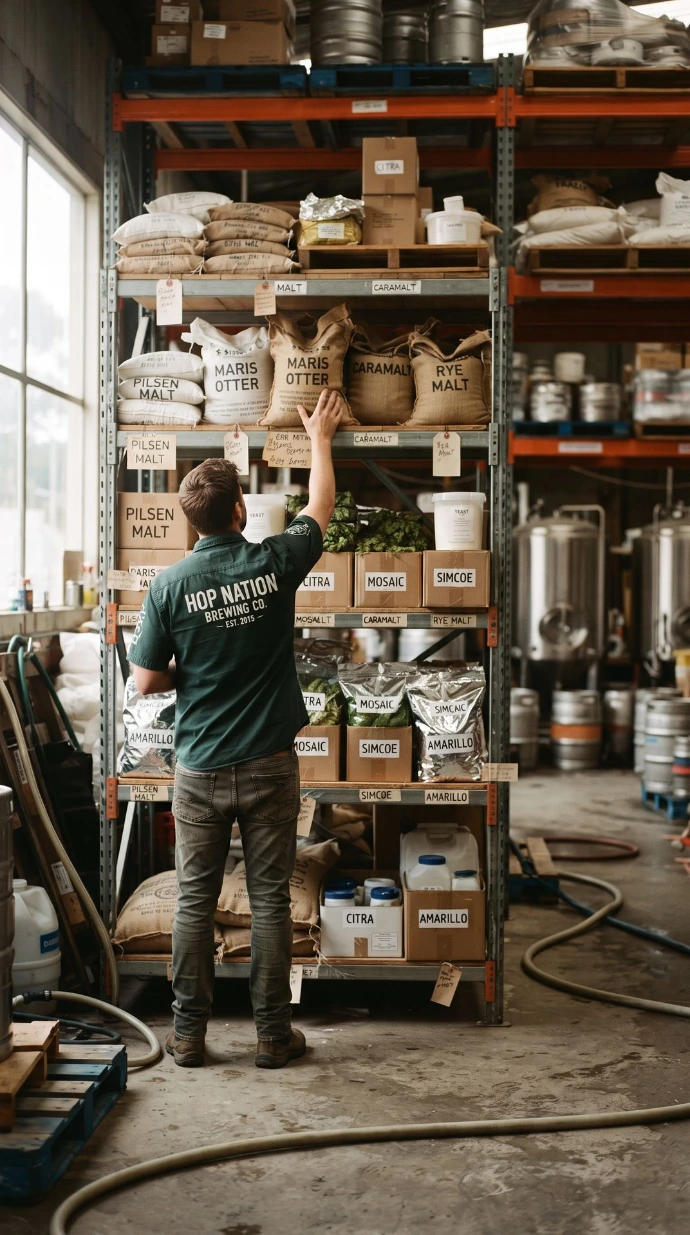
In addition, inventory can be located:
- In a raw materials warehouse.
- In the production area.
- In a fermentation tank.
- In a storage tank.
- In a wooden barrel.
- In an IBC.
- At an external producer.
- In a tax goods warehouse.
- In a store.
- In an external fulfillment warehouse.
- On the way to a customer.
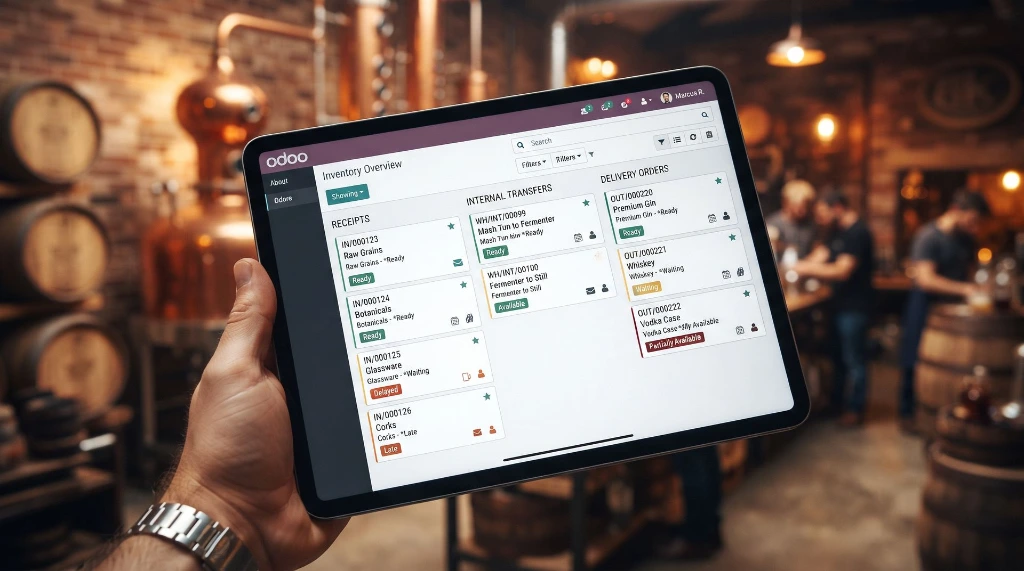
Odoo makes these locations visible separately. Inventory movements are recorded as soon as material is received, moved, consumed, produced, bottled, or delivered. As a result, an entrepreneur can see not only how much inventory is administratively present, but also where this inventory is located and what status it has.
Real-time inventory from raw material to finished product
A beverage producer does not have just one type of inventory. There are raw materials, additives, alcohol-containing base products, yeast, malt, hops, botanicals, sugars, aromas, bottles, cans, caps, corks, labels, boxes, semi-finished products, and finished products.
In addition, inventory can be located:
- In a raw materials warehouse.
- In the production area.
- In a fermentation tank.
- In a storage tank.
- In a wooden barrel.
- In an IBC.
- At an external producer.
- In a tax goods warehouse.
- In a store.
- In an external fulfillment warehouse.
- On the way to a customer.
- Odoo makes these locations individually visible.
Inventory movements are recorded as soon as material is received, moved, consumed, produced, bottled, or delivered. This way, a business owner can see not only how much inventory is administratively present, but also where this inventory is located and what status it has.
Smart replenishment of raw materials and packaging
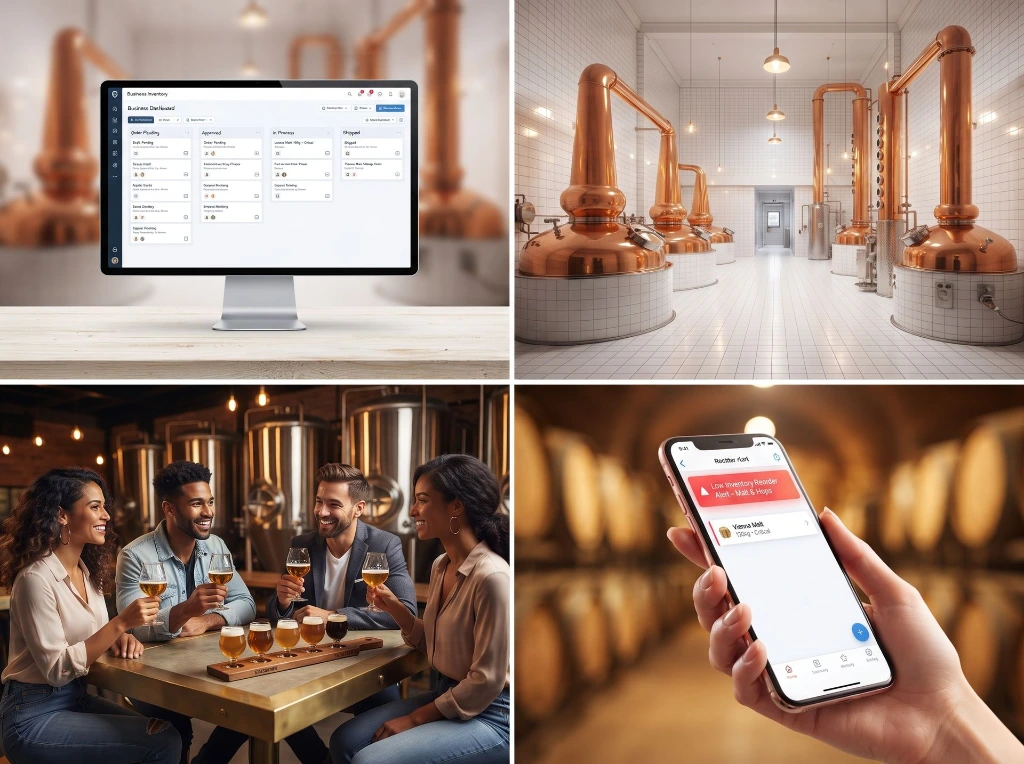
Based on minimum stock levels, expected sales, and planned production, Odoo can help determine what needs to be purchased.
This allows the system to signal that, for example:
Insufficient bottles are available for a planned bottling.
A certain type of malt needs to be ordered.
Labels are almost out.
A packaging has a longer delivery time.
A production cannot be fully executed.
A popular end product is falling below the desired stock.
Purchasing, production, and sales thus become part of the same planning.
Smart replenishment of raw materials and packaging
Based on minimum stock levels, expected sales, and planned production, Odoo can help determine what needs to be purchased.
This allows the system to signal that, for example:
Insufficient bottles are available for a planned bottling.
A certain type of malt needs to be ordered.
Labels are almost out.
A packaging has a longer delivery time.
A production cannot be fully executed.
A popular end product is falling below the desired stock.
Purchasing, production, and sales thus become part of the same planning.
Navigation menu
Batches, lot numbers, and full traceability
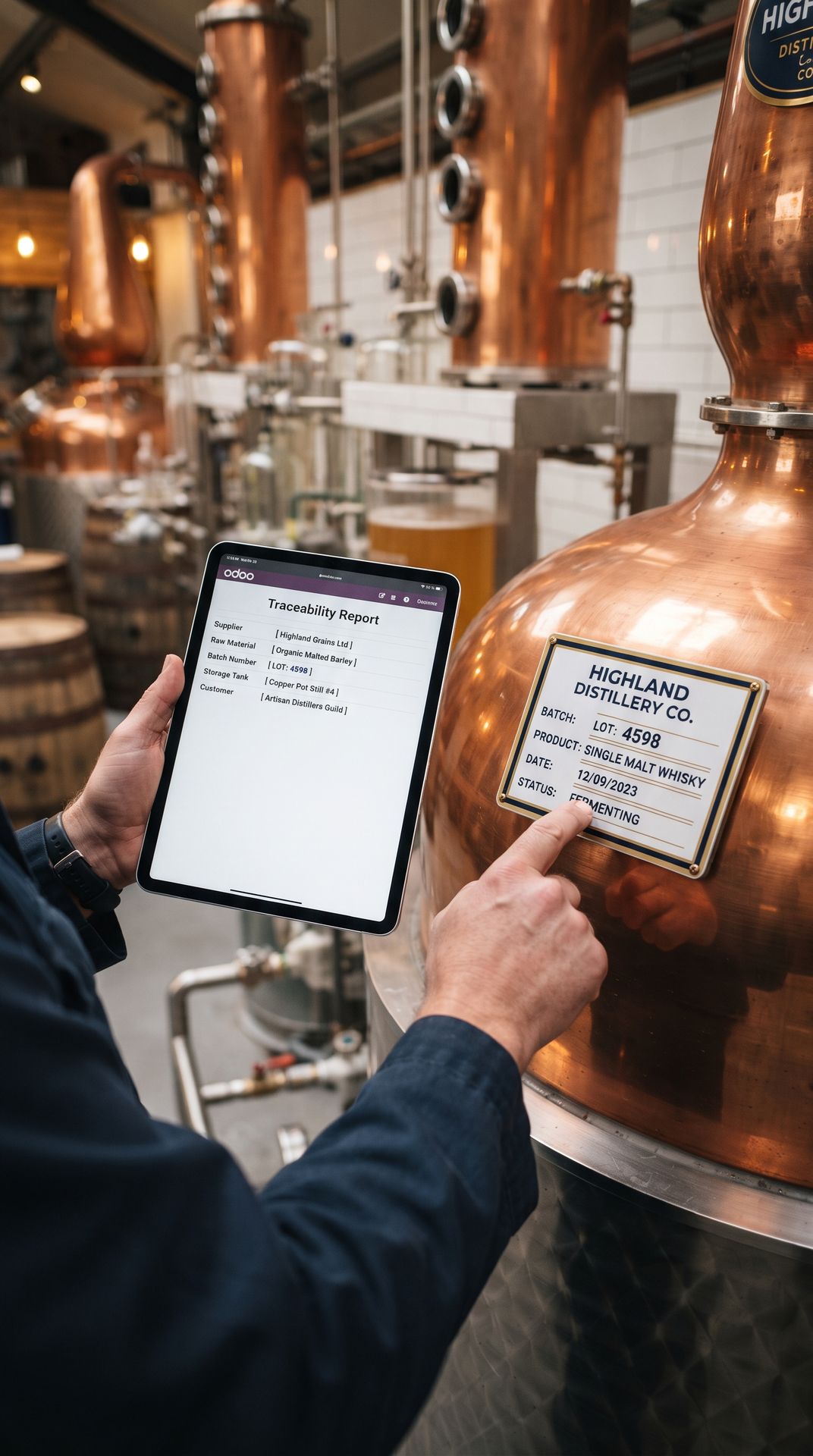
Traceability and batch numbers
Traceability is essential for food safety, quality control, and professional inventory management.
With batch and lot number registration, the following can be recorded:
Which supplier a raw material comes from.
When this raw material was received.
In which production batch the raw material was used.
Which semi-finished products were created from it.
In which tank, barrel, or storage location the product has been.
When it was bottled.
Which end products were created from the batch.
To which customers these products were delivered.
In case of a deviation, it can be determined more quickly which products, productions, and customers are involved.
From supplier to customer
A well-organized traceability provides answers to two crucial questions:
Where did the product or ingredient come from? The supplier, receipt, date, quantity, and lot number can be traced.
Where has the product gone? The production used, resulting end products, deliveries, and customers are visible.
This helps with internal controls, audits, complaint investigations, and any recalls.
Batches, lot numbers, and full traceability
Traceability and batch numbers
Traceability is essential for food safety, quality control, and professional inventory management.
With batch and lot number registration, the following can be recorded:
Which supplier a raw material comes from.
When this raw material was received.
In which production batch the raw material was used.
Which semi-finished products were created from it.
In which tank, barrel, or storage location the product has been.
When it was bottled.
Which end products were created from the batch.
To which customers these products were delivered.
In case of a deviation, it can be determined more quickly which products, productions, and customers are involved.
From supplier to customer
A well-organized traceability provides answers to two crucial questions:
Where did the product or ingredient come from? The supplier, receipt, date, quantity, and lot number can be traced.
Where has the product gone? The production used, resulting end products, deliveries, and customers are visible.
This helps with internal controls, audits, complaint investigations, and any recalls.
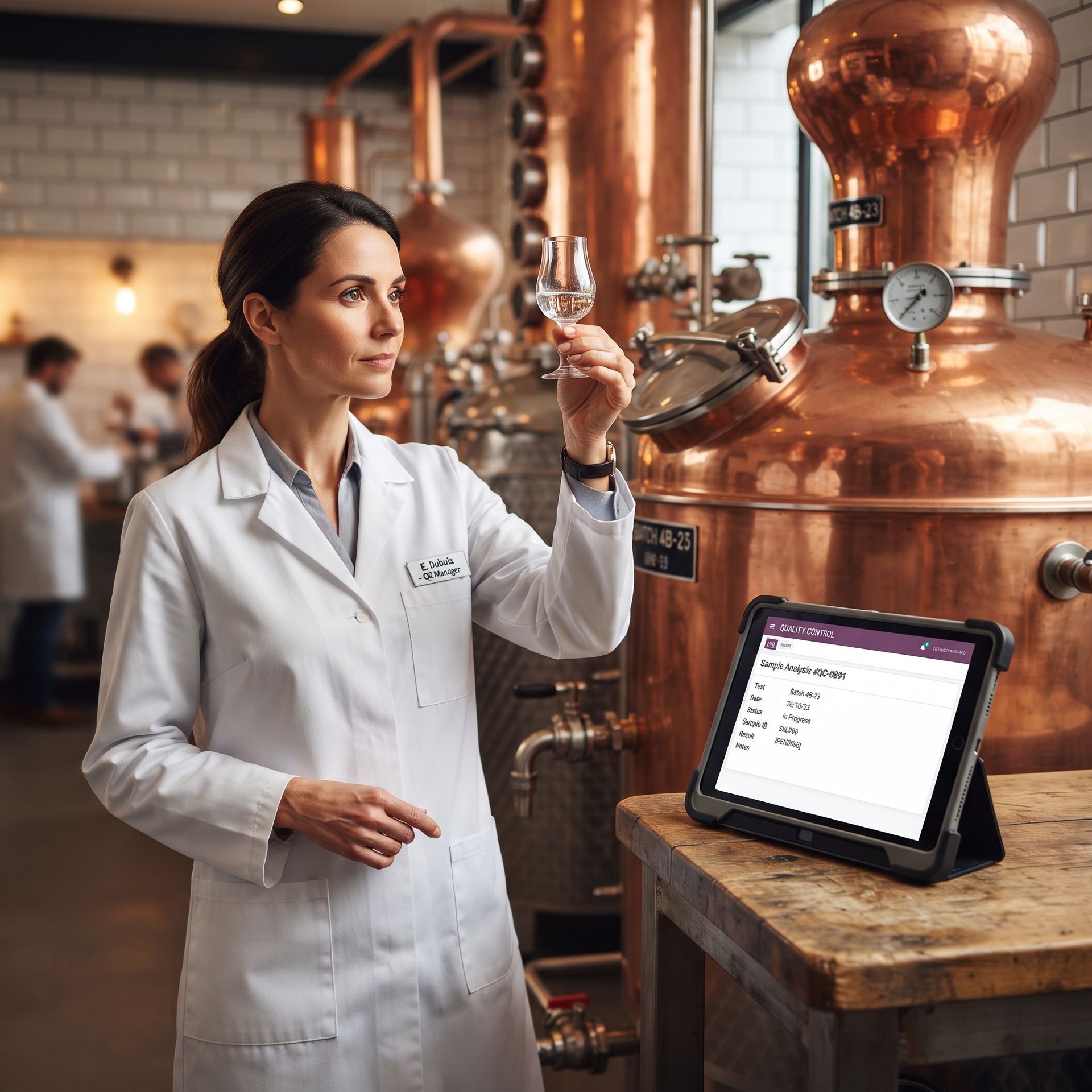
HACCP, APPCC, and Sanidad clearly register
Food safety should not be separate from daily production.
Controls on cleaning, temperature, alcohol percentage, packaging, allergens, equipment, and product quality must be performed when needed
HACCP, APPCC, and Sanidad clearly register
Food safety should not be separate from daily production.
Controls on cleaning, temperature, alcohol percentage, packaging, allergens, equipment, and product quality must be performed when needed.
Newconomie can link quality controls and registrations to:
Receipt of raw materials.
Separate production steps.
Tanks and production lines.
Bottling and packaging.
Warehouse movements.
Delivery of end products.
Specific products or product groups.
Examples of registrations
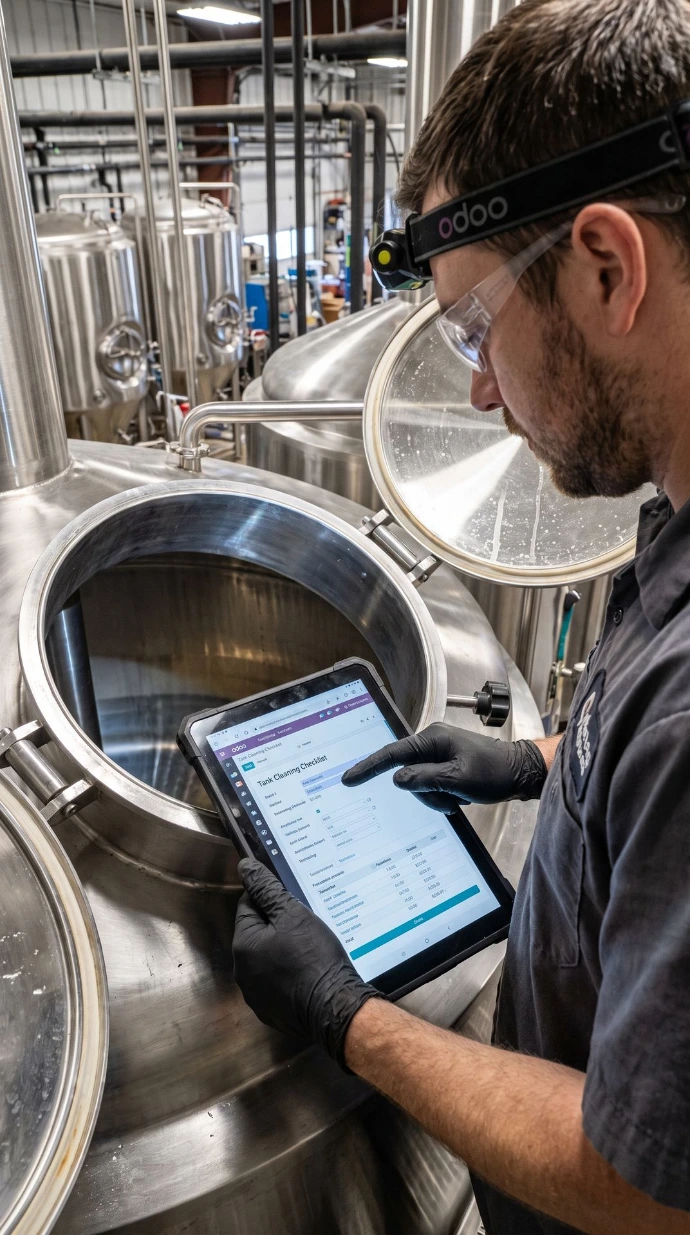
Within a configured Odoo environment, the following controls can be recorded:
- Cleaning and disinfection.
- Control of tanks, pipes, and equipment.
- Temperatures.
- Density, pH, or other measurements.
- Alcohol percentage.
- Visual product control.
- Control of bottle, cap, cork, or closure.
- Control of labels and batch information.
- Allergen registration.
- Sampling.
- Maintenance and calibration.
- Pest prevention.
- Deviations and blockages.
- Corrective actions.
- Complaints and quality incidents.
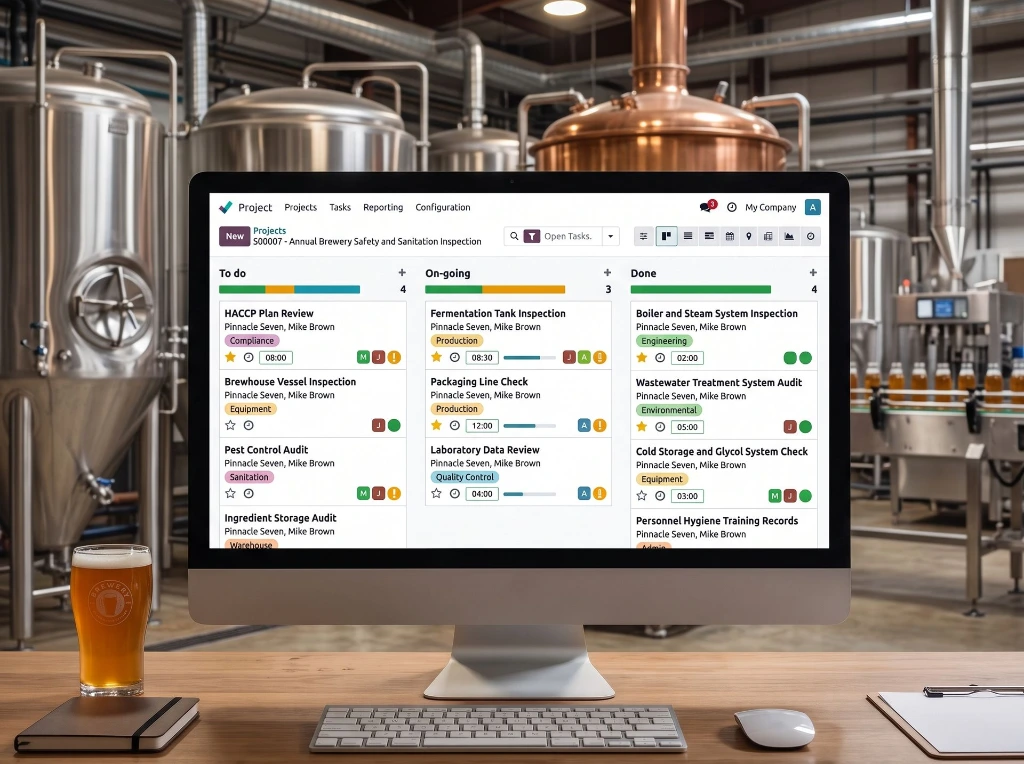
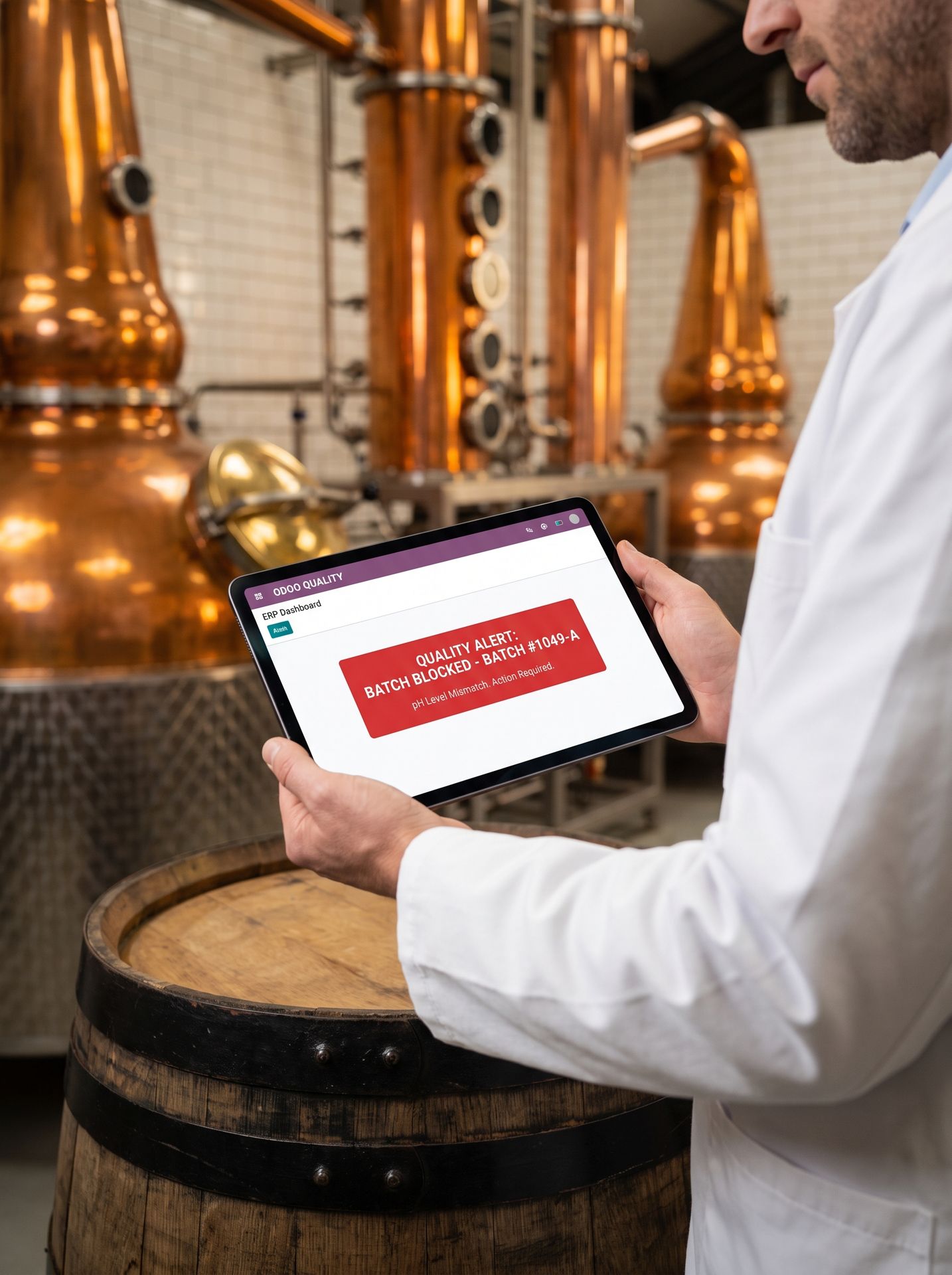
When a control is not approved, a follow-up action can be created. A batch can, for example, be blocked, rechecked, or assigned to a responsible employee.
Registrations to make demonstrable
During an inspection, it is not only about the existence of a procedure. It must also be demonstrable
that controls have actually been carried out.
Therefore, data can be stored per registration such as:
● Date and time
● Responsible employee
● Measured value
● Approval or rejection
● Explanation
● Photo or document
● Applied correction
● Follow-up control
Odoo supports the implementation and documentation of the food safety plan.
Examples of registrations
Within a configured Odoo environment, the following controls can be recorded:
- Cleaning and disinfection.
- Control of tanks, pipes, and equipment.
- Temperatures.
- Density, pH, or other measurements.
- Alcohol percentage.
- Visual product control.
- Control of bottle, cap, cork, or closure.
- Control of labels and batch information.
- Allergen registration.
- Sampling.
- Maintenance and calibration.
- Pest prevention.
- Deviations and blockages.
- Corrective actions.
- Complaints and quality incidents.
When a control is not approved, a follow-up action can be created. A batch can, for example, be blocked, rechecked, or assigned to a responsible employee.
Registrations to make demonstrable
During an inspection, it is not only about the existence of a procedure. It must also be demonstrable
that controls have actually been carried out.
Therefore, data can be stored per registration such as:
● Date and time
● Responsible employee
● Measured value
● Approval or rejection
● Explanation
● Photo or document
● Applied correction
● Follow-up control
Odoo supports the implementation and documentation of the food safety plan.
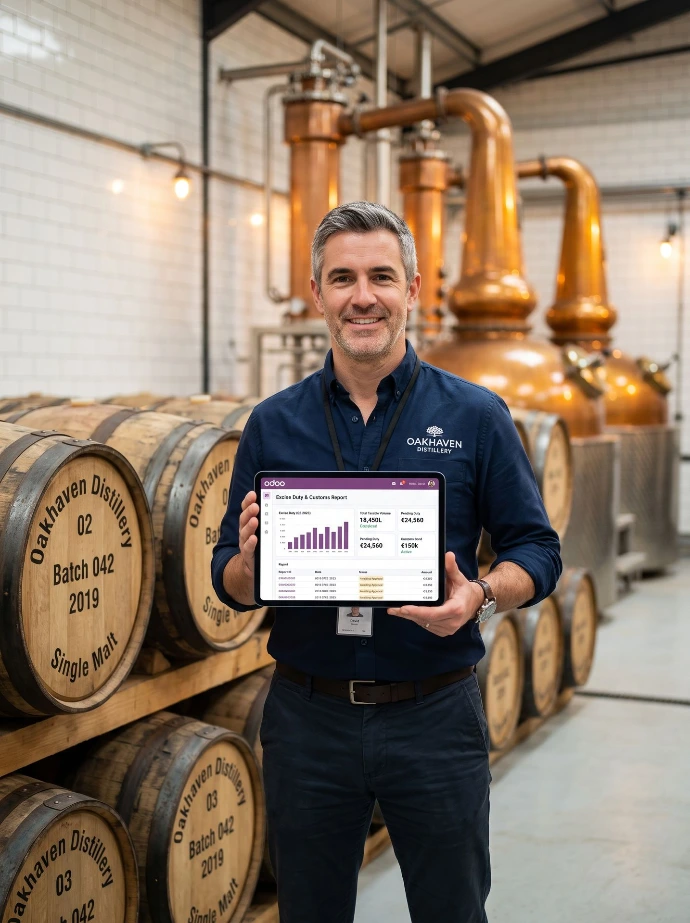
Excise administration that connects to the physical inventory
For breweries and distilleries, excise is not a separate accounting topic. Excise is directly linked to production, volume, alcohol percentage, inventory status, and goods movements.
An administrative inventory that does not match the physical inventory can have significant consequences. Therefore, every relevant production and movement must be recorded in a consistent manner.
Depending on the company and the country, differentiation may be necessary between:
Raw materials with and without alcohol.
Products in production.
Bulk inventory.
Finished product.
Stock under excise suspension.
Excise stock.
Internal transfers.
Production differences.
Permitted losses.
Breakage or destruction.
Own use.
Domestic deliveries.
Intra-community movements.
Export.
Returns.
Excise administration that connects to the physical inventory
For breweries and distilleries, excise is not a separate accounting topic. Excise is directly linked to production, volume, alcohol percentage, inventory status, and goods movements.
An administrative inventory that does not match the physical inventory can have significant consequences. Therefore, every relevant production and movement must be recorded in a consistent manner.
Depending on the company and the country, differentiation may be necessary between:
Raw materials with and without alcohol.
Products in production.
Bulk inventory.
Finished product.
Stock under excise suspension.
Excise stock.
Internal transfers.
Production differences.
Permitted losses.
Breakage or destruction.
Own use.
Domestic deliveries.
Intra-community movements.
Export.
Returns.
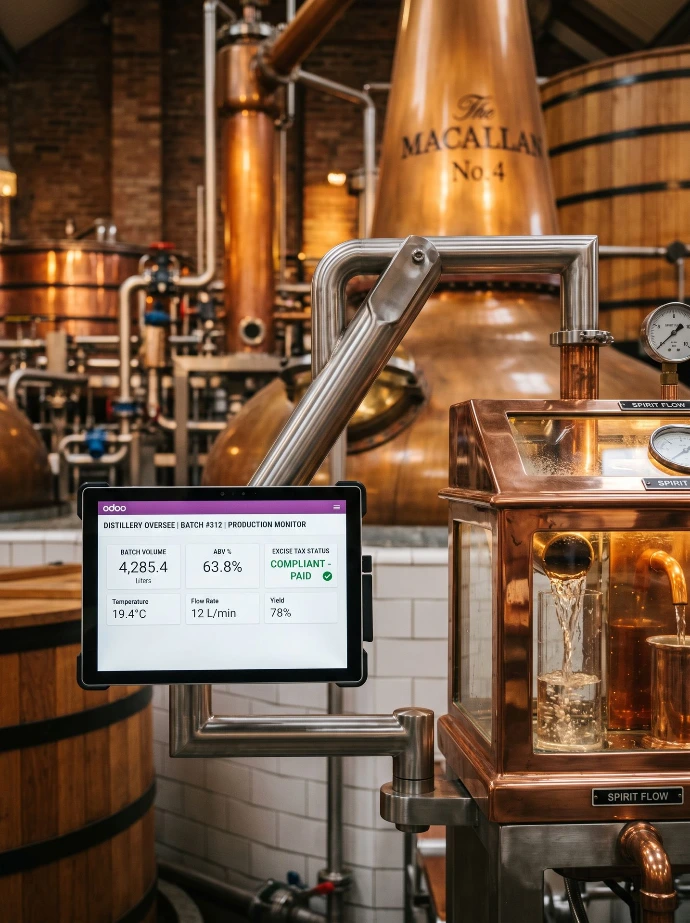
Odoo as a source administration for excise
Newconomie can configure Odoo so that production and stock movements provide the necessary source data for the excise administration.
This can include:
Product codes and tax classifications.
Alcohol percentage and content.
Actual produced quantities.
Beginning and ending inventory.
Receipts and outputs.
Production, processing, and bottling.
Differences and losses.
Tax status per location.
Documents for goods movements.
Reports per product, period, or warehouse.
As a result, the excise administration does not need to be fully reconstructed afterwards.
Odoo as a source administration for excise
Newconomie can configure Odoo so that production and stock movements provide the necessary source data for the excise administration.
This can include:
Product codes and tax classifications.
Alcohol percentage and content.
Actual produced quantities.
Beginning and ending inventory.
Receipts and outputs.
Production, processing, and bottling.
Differences and losses.
Tax status per location.
Documents for goods movements.
Reports per product, period, or warehouse.
As a result, the excise administration does not need to be fully reconstructed afterwards.
EMCS, SILICIE and national obligations
Odoo does not automatically replace official government portals.
For goods movements under excise suspension within the European Union, EMCS is used, for example. In Spain, SILICIE may apply for the administration of certain excise goods. Other countries have their own declarations, portals, and procedures.
Newconomie investigates per implementation:
What obligations apply to the company.
What data from Odoo is needed.
What registrations can be built automatically.
What exports or reports are needed.
Whether a technical connection is possible and responsible.
What actions need to be checked or approved.
The premise remains that the data in Odoo corresponds with the actual production and physical stock.
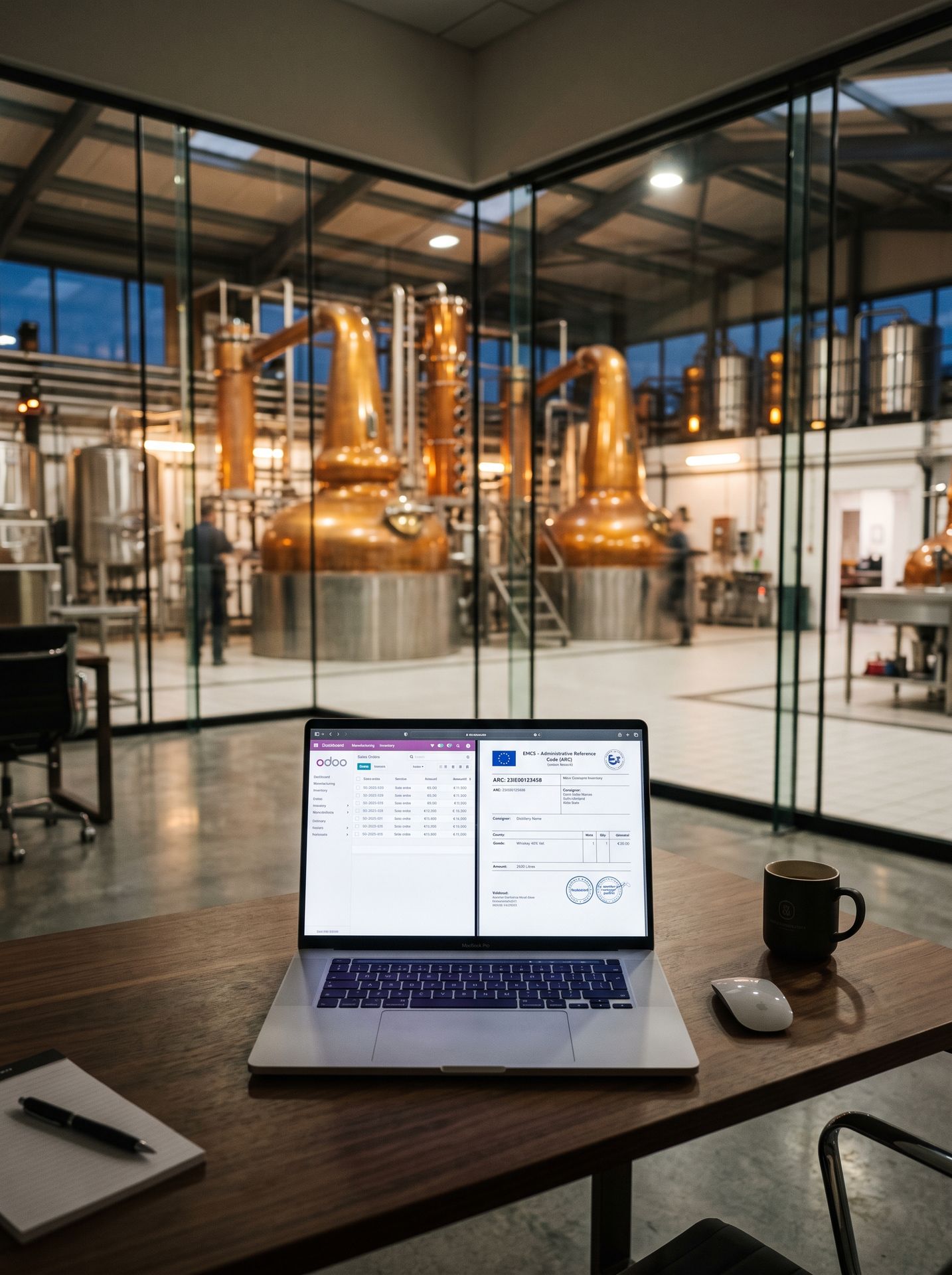
EMCS, SILICIE and national obligations
Odoo does not automatically replace official government portals.
For goods movements under excise suspension within the European Union, EMCS is used, for example. In Spain, SILICIE may apply for the administration of certain excise goods. Other countries have their own declarations, portals, and procedures.
Newconomie investigates per implementation:
What obligations apply to the company.
What data from Odoo is needed.
What registrations can be built automatically.
What exports or reports are needed.
Whether a technical connection is possible and responsible.
What actions need to be checked or approved.
The premise remains that the data in Odoo corresponds with the actual production and physical stock.
Navigation menu
Bottling, labeling, and packaging
A bulk product is administratively not the same as a bottled finished product.
During bottling, a quantity changes into a specific number of sellable units. In the process, bottles, caps, corks, labels, boxes, and other packaging materials are also consumed.
In Odoo, a bottling or packaging order can, for example, register:
Which bulk batch is used.
How many liters are available.
What bottle content is applied.
How many bottles can theoretically be produced.
How many bottles have actually been filled.
How much loss has occurred.
What packaging materials have been consumed.
What lot number the final product receives.
How many boxes or pallets have been formed.
Where the final products are stored.
Different types of packaging can be managed separately. Think of the same spirit in 50 cl, 70 cl, gift packaging, or private-label versions.
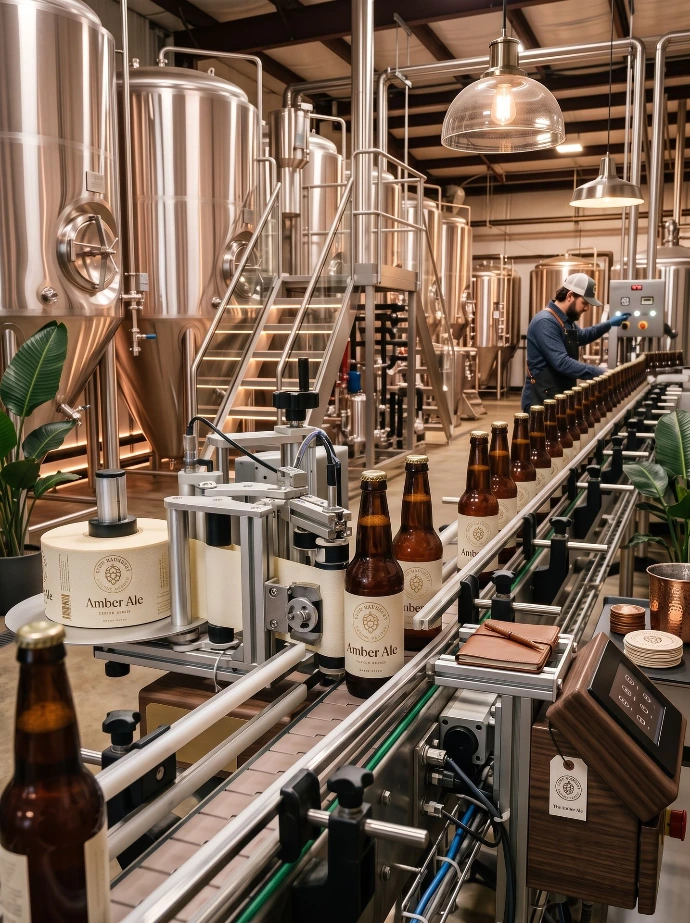
Bottling, labeling, and packaging
A bulk product is administratively not the same as a bottled finished product.
During bottling, a quantity changes into a specific number of sellable units. In the process, bottles, caps, corks, labels, boxes, and other packaging materials are also consumed.
In Odoo, a bottling or packaging order can, for example, register:
Which bulk batch is used.
How many liters are available.
What bottle content is applied.
How many bottles can theoretically be produced.
How many bottles have actually been filled.
How much loss has occurred.
What packaging materials have been consumed.
What lot number the final product receives.
How many boxes or pallets have been formed.
Where the final products are stored.
Different types of packaging can be managed separately. Think of the same spirit in 50 cl, 70 cl, gift packaging, or private-label versions.
Quality, maintenance, and deviations in one workflow
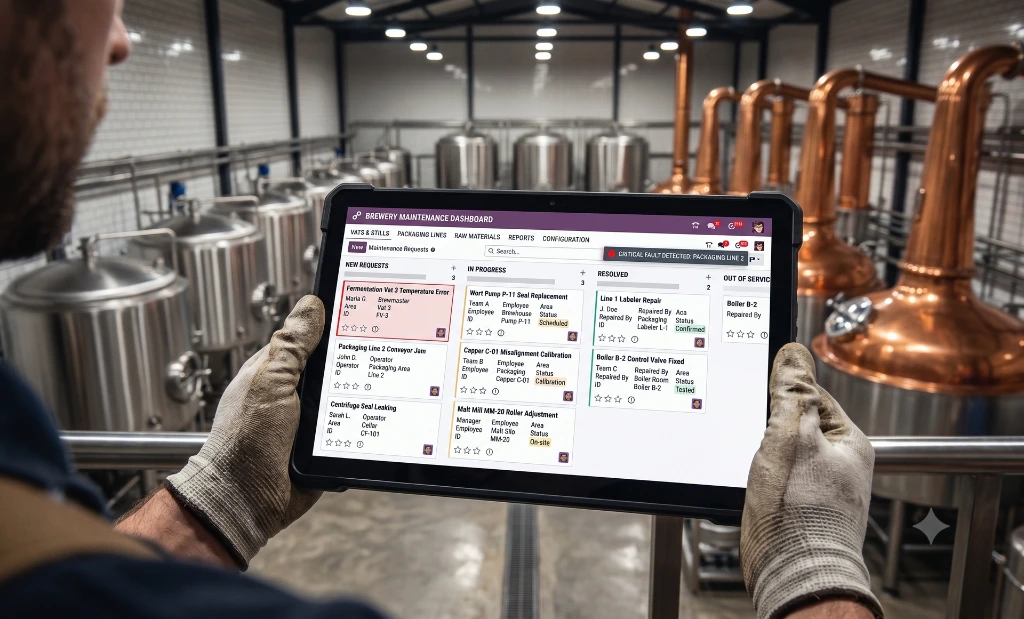
Quality issues do not always arise from a raw material or recipe. Equipment, maintenance,
cleaning, and calibration also play a role.
Therefore, maintenance and quality can be linked to the production environment.
Examples include:
Maintenance and calibration
Periodic maintenance of pumps and filling machines.
Control of measuring equipment.
Calibration of thermometers or alcohol meters.
Reporting defects from the shop floor.
Blocking a machine or work center.
Recording downtime.
Follow-up on repairs.
Analysis of recurring deviations.
When an employee identifies a problem, it can be reported and assigned immediately. This prevents technical deviations from getting lost in separate messages or paper notes.
Quality, maintenance, and deviations in one workflow
Quality issues do not always arise from a raw material or recipe. Equipment, maintenance,
cleaning, and calibration also play a role.
Therefore, maintenance and quality can be linked to the production environment.
Examples include:
Maintenance and calibration
Periodic maintenance of pumps and filling machines.
Control of measuring equipment.
Calibration of thermometers or alcohol meters.
Reporting defects from the shop floor.
Blocking a machine or work center.
Recording downtime.
Follow-up on repairs.
Analysis of recurring deviations.
When an employee identifies a problem, it can be reported and assigned immediately. This prevents technical deviations from disappearing into loose messages or paper notes.
Sales to hospitality, liquor stores, wholesale and consumers
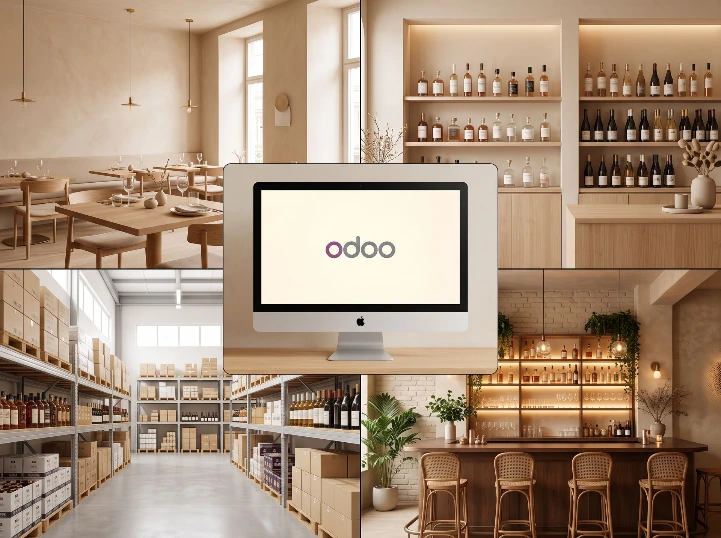
Many breweries and distilleries sell through multiple channels.
A product can be sold to:
Hospitality.
Liquor stores.
Beverage trades.
Wholesalers.
Distributors.
Importers.
Business end customers.
Consumers.
Own stores.
International customers.
Each channel has different prices, packaging, minimum orders, payment agreements, and delivery conditions. Odoo can support these sales flows within one environment.
Sales to hospitality, liquor stores, wholesale and consumers
Many breweries and distilleries sell through multiple channels.
A product can be sold to:
Hospitality.
Liquor stores.
Beverage trades.
Wholesalers.
Distributors.
Importers.
Business end customers.
Consumers.
Own stores.
International customers.
Each channel has different prices, packaging, minimum purchases, payment agreements, and delivery terms. Odoo can support these sales flows within one environment.
B2B sales
For business customers, the following can be set up:
Customer-specific price lists.
Tiered pricing.
Box prices.
Minimum order quantities.
Quotes.
Sales orders.
Payment terms.
Credit limits.
Representatives.
Customer portals.
Repeat orders.
Delivery routes.
Invoicing after delivery.
B2C sales
For consumers, the webshop, online payment, inventory, order processing, and shipping can be directly linked.
A paid webshop order can automatically lead to:
A sales order.
Reservation of stock.
A warehouse task.
A delivery or pickup.
An invoice.
An updated inventory level.
Processing in accounting.
Cash register and tasting room
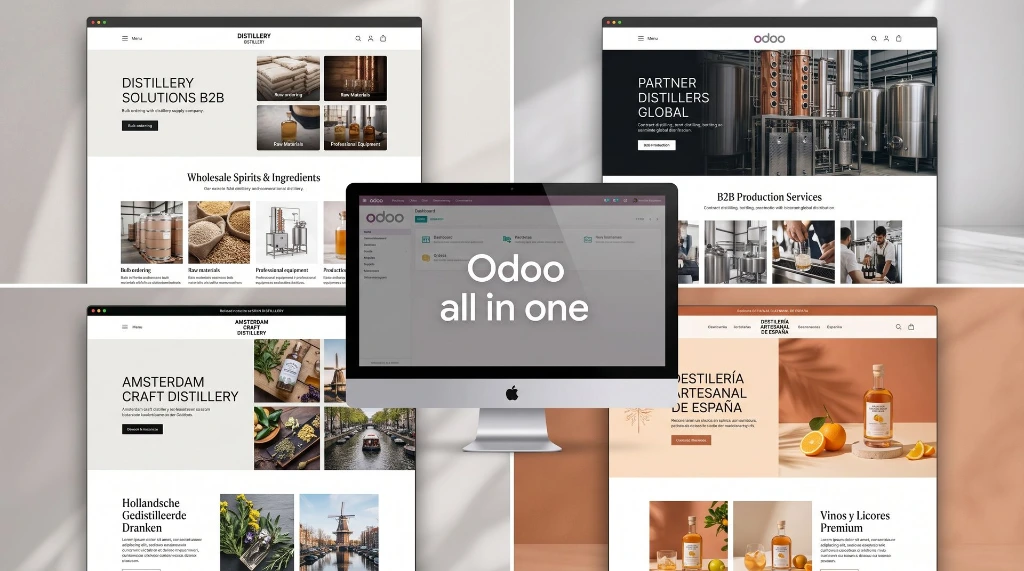
If the brewery or distillery also has a shop, tasting room, or visitor center, Odoo Point of Sale can be linked to the same products, inventory, and administration. This way, retail sales, tours, tastings, webshop orders, and business sales are no longer separate administrations.
B2B sales
For business customers, the following can be set up:
- Customer-specific price lists.
Tiered pricing.
Box prices.
Minimum order quantities.
Quotes.
Sales orders.
Payment terms.
Credit limits.
Representatives.
Customer portals.
Repeat orders.
Delivery routes.
Invoicing after delivery.
B2C sales
For consumers, the webshop, online payment, inventory, order processing, and shipping can be directly linked.
A paid webshop order can automatically lead to:
A sales order.
Reservation of stock.
A warehouse task.
A delivery or pickup.
An invoice.
An updated inventory level.
Processing in accounting.
Cash register and tasting room
If the brewery or distillery also has a shop, tasting room, or visitor center, Odoo Point of Sale can be linked to the same products, inventory, and administration. This way, retail sales, tours, tastings, webshop orders, and business sales are no longer separate administrations.
Private label and production for third parties
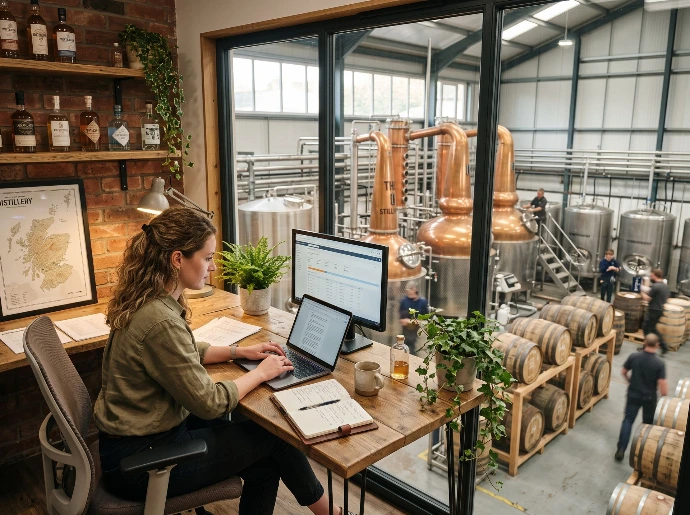
Private label production requires strict agreements.
Different requirements may apply per client for formulation, bottle, label, packaging, quantity, price
and delivery date.
Odoo can provide support with:
Customer requests.
Product development.
Quotes.
Approval moments.
Formulations.
Packaging specifications.
Documents and designs.
Production planning.
Minimum orders.
Customer-specific inventories.
Bottling and packaging.
Delivery and invoicing.
Repeat orders.
This makes private label a manageable process instead of a collection of loose emails, files, and agreements.
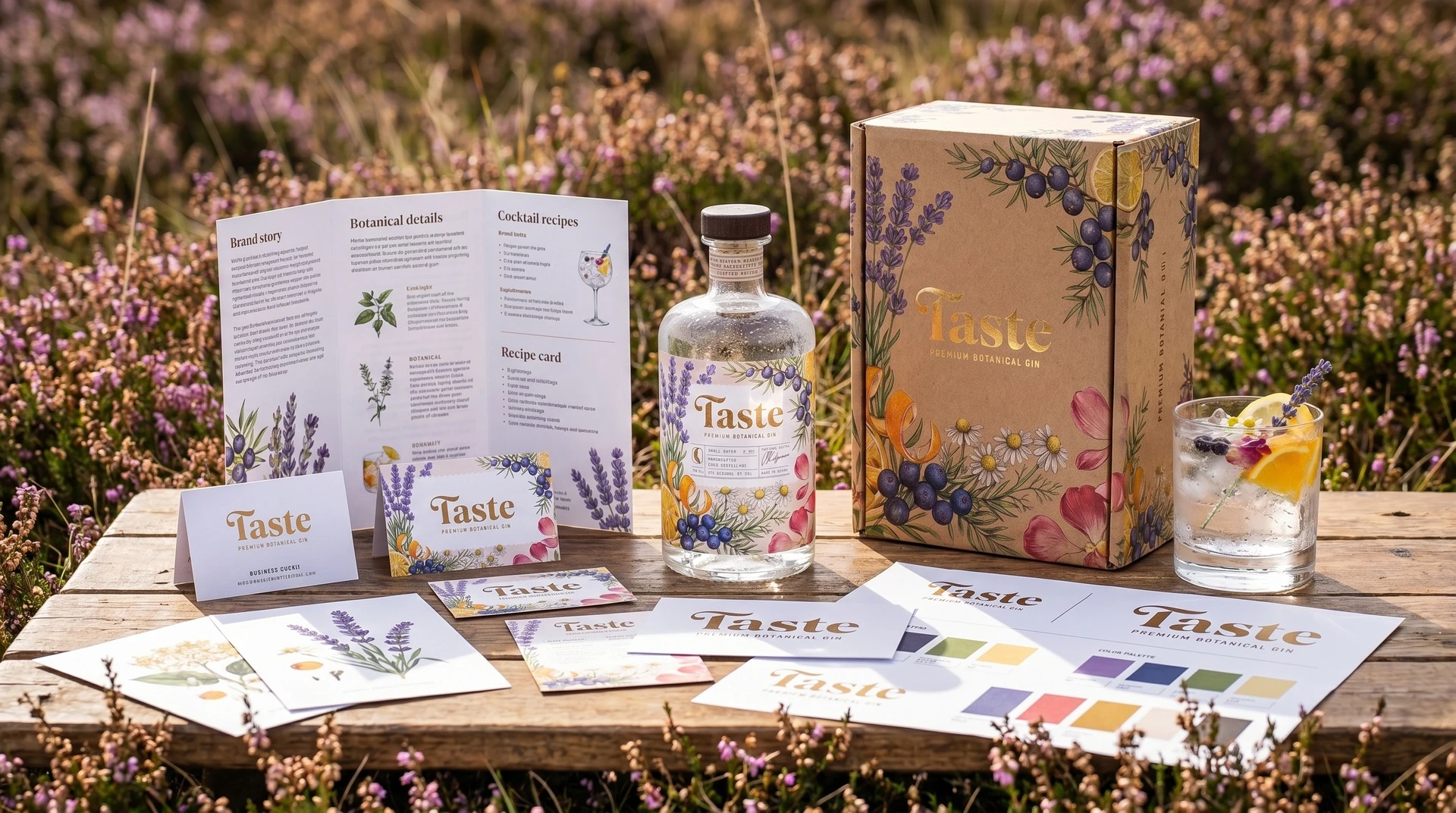
Private label and production for third parties
Private-label production requires strict agreements.
Different requirements may apply per client for recipe, bottle, label, packaging, quantity, price,
and delivery date.
Odoo can provide support for:
- Customer requests.
Product development.
Quotes.
Approval moments.
Formulations.
Packaging specifications.
Documents and designs.
Production planning.
Minimum orders.
Customer-specific inventories.
Bottling and packaging.
Delivery and invoicing.
Repeat orders.
This makes private label a manageable process instead of a collection of separate emails, files, and agreements.
Websites and webshops linked to the business operations
Newconomie can realize within Odoo among other things:
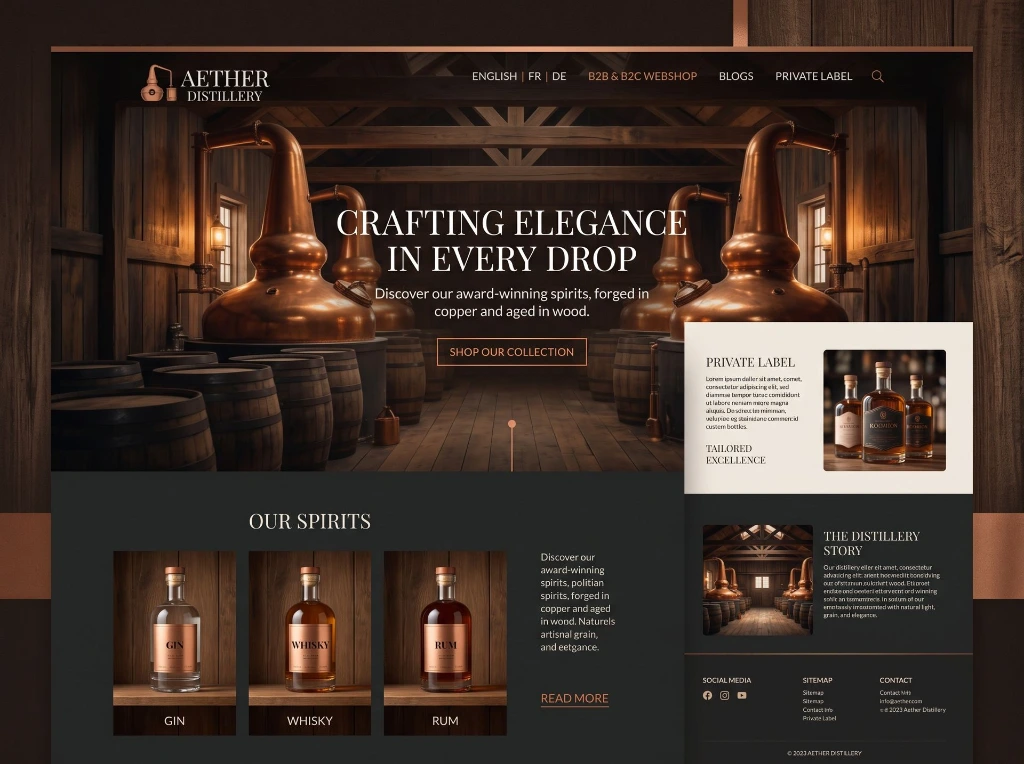
A corporate website.
A consumer webshop.
A secured business webshop.
Different websites per brand.
Different websites per country.
Multiple languages.
Customer-specific prices.
Dealer or distributor pages.
Private label requests.
Tours and events.
Blogs and landing pages.
Newsletters.
Forms and CRM follow-up.
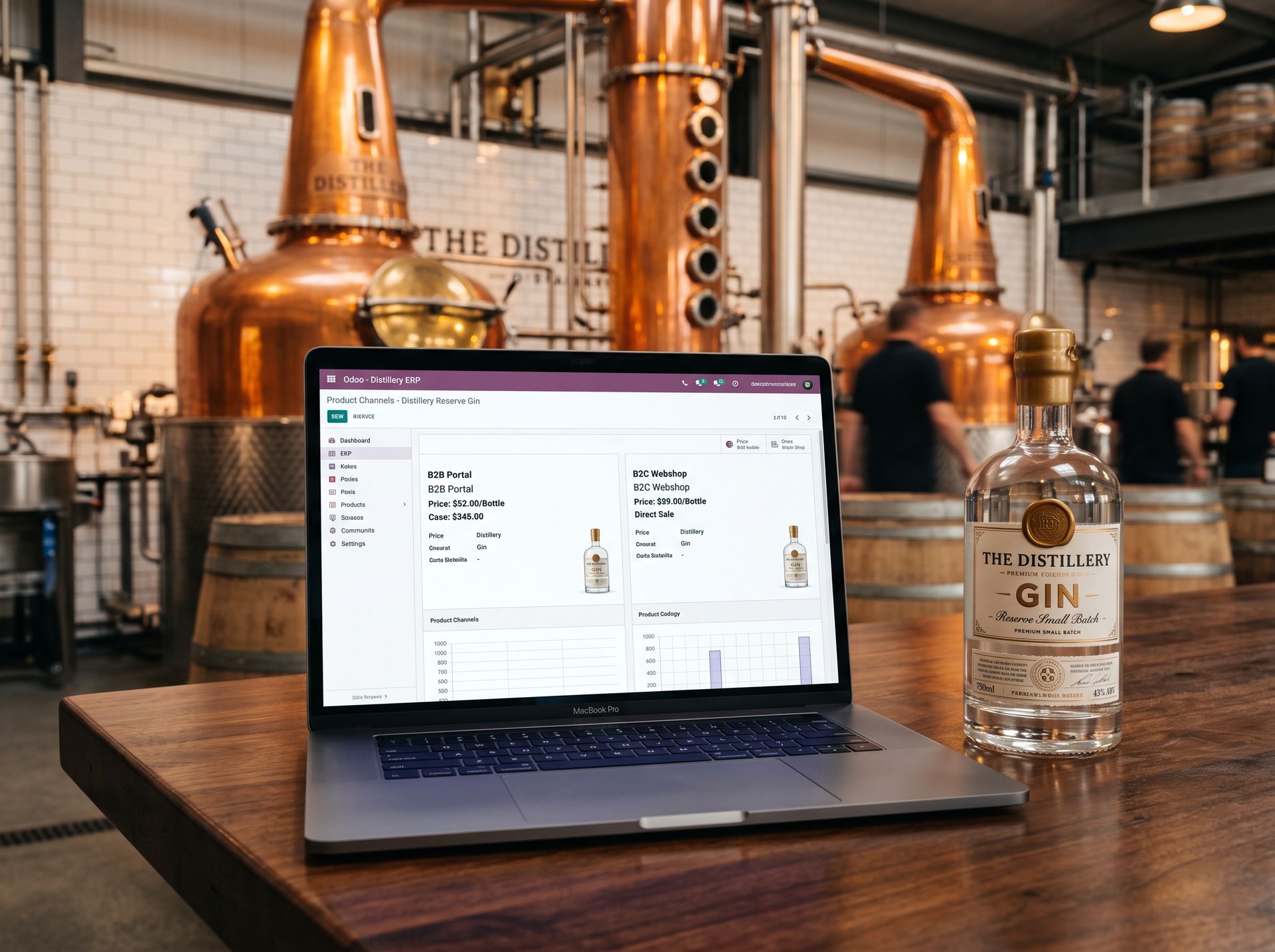
One product, multiple sales channels
Product information can be centrally managed and then used for different websites or target groups.
Different choices can be made per website for:
Assortment.
Product description.
Language.
Price.
Tax.
Packaging.
Availability.
Images.
Target group.
Business or private sales.
The webshop is therefore not separate from the ERP system. The webshop is part of the same business operations.
Websites and webshops linked to the business operations
Newconomie can realize within Odoo among other things:
A corporate website.
A consumer webshop.
A secured business webshop.
Different websites per brand.
Different websites per country.
Multiple languages.
Customer-specific prices.
Dealer or distributor pages.
Private label requests.
Tours and events.
Blogs and landing pages.
Newsletters.
Forms and CRM follow-up.
One product, multiple sales channels
Product information can be centrally managed and then used for different websites or target groups.
Different choices can be made per website for:
Assortment.
Product description.
Language.
Price.
Tax.
Packaging.
Availability.
Images.
Target group.
Business or private sales.
The webshop is therefore not separate from the ERP system. The webshop is part of the same business operations.
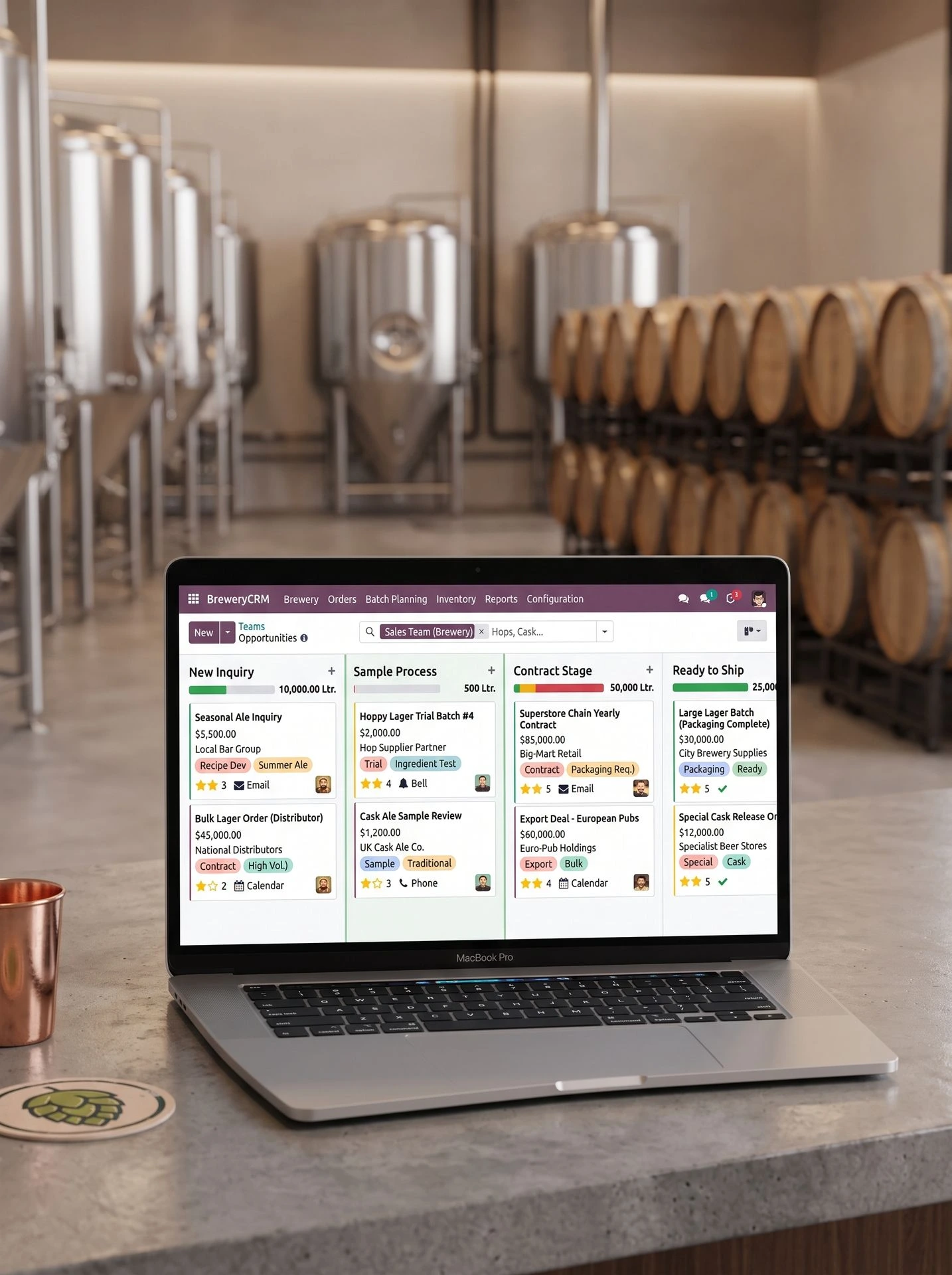
CRM, marketing and customer follow-up
Not every visitor orders directly. A hospitality entrepreneur may first request a price list. A distributor wants to receive samples. A private label customer wants a product proposal. A liquor store wants to be called back.
These requests can automatically enter the CRM. After that, tasks and follow-up moments can be created for:
Introductory meetings.
Samples.
Quotes.
Tastings.
Distributors.
Private label projects.
International requests.
Repeat orders.
Marketing campaigns.
Newsletters, segmentation, and marketing automation can be linked to customer data and previous activities. This not only creates a good production process but also a commercial structure that allows the company to grow.
CRM, marketing and customer follow-up
Not every visitor orders directly. A hospitality entrepreneur may first request a price list. A distributor wants to receive samples. A private label customer wants a product proposal. A liquor store wants to be called back.
These requests can automatically enter the CRM. After that, tasks and follow-up moments can be created for:
Introductory meetings.
- Samples.
- Quotes.
- Tastings.
- Distributors.
- Private label projects.
- International requests.
- Repeat orders.
- Marketing campaigns.
Newsletters, segmentation, and marketing automation can be linked to customer data and previous activities. This not only creates a good production process but also a commercial structure that allows the company to grow.
Navigation menu
Accounting and cost calculation
To make good decisions, it must be clear what a product actually costs.
The cost price of beer or distilled spirits does not only consist of the main raw material. Packaging,
labor, energy, storage, production losses, transport, and excise duties can also have an impact.
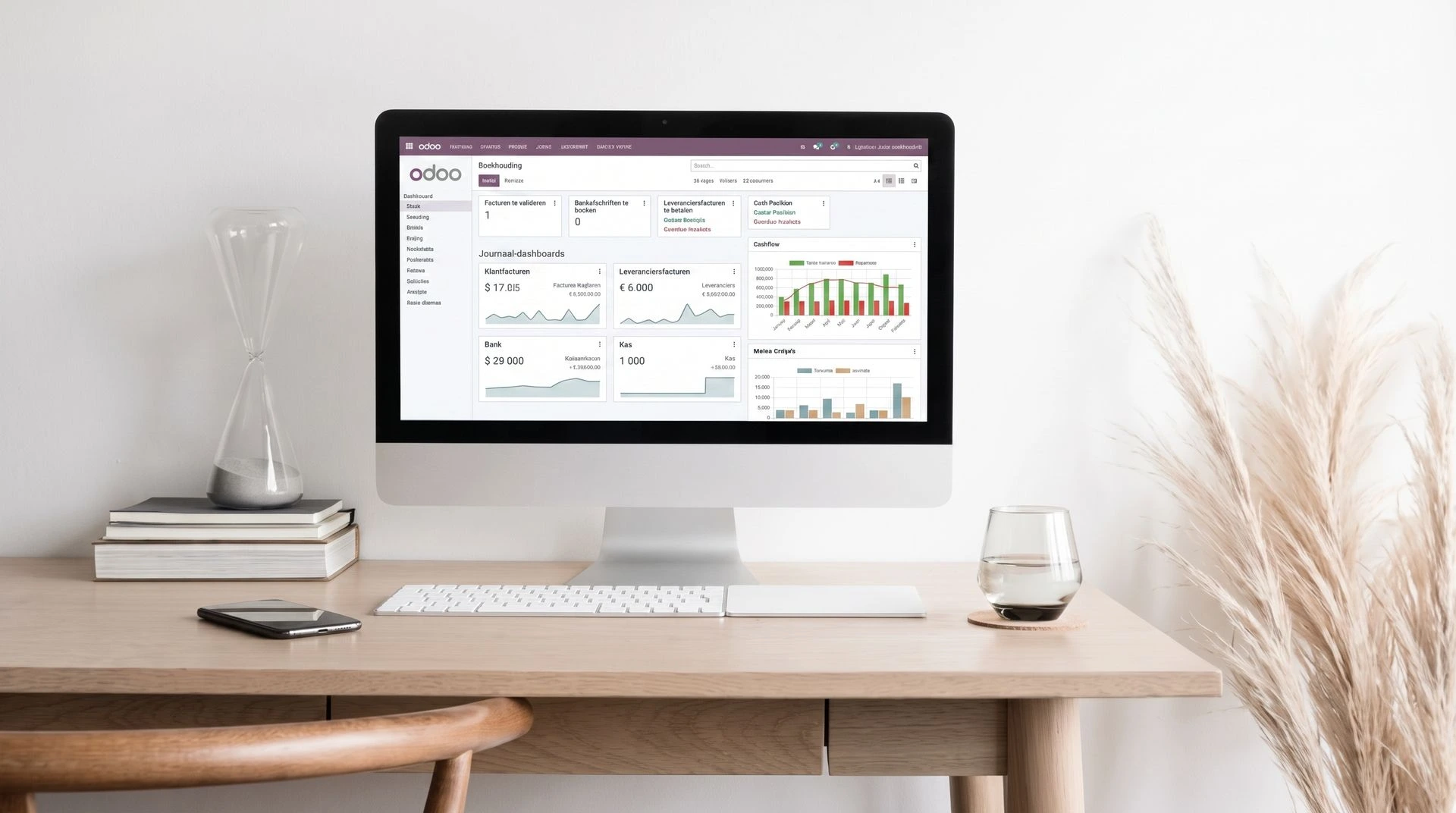
Depending on the chosen setup, Odoo can provide insight into:
Material consumption.
Packaging costs.
Time per production step.
Actual production yield.
Production losses.
Costs per production order.
Costs per batch.
Inventory value.
Margin per product.
Margin per customer.
Margin per sales channel.
Revenue per country, website, or company.
Sales, production, inventory, and accounting thus use the same basic data.
Accounting and cost calculation
To make good decisions, it must be clear what a product actually costs.
The cost price of beer or distilled spirits does not only consist of the main raw material. Packaging,
labor, energy, storage, production losses, transport, and excise duties can also have an impact.
Depending on the chosen setup, Odoo can provide insight into:
Material consumption.
Packaging costs.
Time per production step.
Actual production yield.
Production losses.
Costs per production order.
Costs per batch.
Inventory value.
Margin per product.
Margin per customer.
Margin per sales channel.
Revenue per country, website, or company.
Sales, production, inventory, and accounting thus use the same basic data.
Multiple companies, countries, warehouses and brands
Beverage companies often do not grow within one simple structure.

From production planning to management information
What productions are scheduled?
Are all raw materials available?
Which batches are still in production?
Which tanks or barrels are occupied?
When can a product be bottled?
Which products are almost sold out?
Which orders need to be delivered?
Which products have the highest margin?
Where do production differences arise?
Which quality controls are still open?
Which inventory is under excise suspension?
Which sales channels are growing?
Which customers need to be followed up?
From production planning to management information
What productions are scheduled?
Are all raw materials available?
Which batches are still in production?
Which tanks or barrels are occupied?
When can a product be bottled?
Which products are almost sold out?
Which orders need to be delivered?
Which products have the highest margin?
Where do production differences arise?
Which quality controls are still open?
Which inventory is under excise suspension?
Which sales channels are growing?
Which customers need to be followed up?
Not everything needs to happen at once
A complete ERP implementation does not mean that every component must go live at the same time.
Newconomie prefers to work in phases:
Phase 1: understanding processes and obligations
We map out the entire business operations:
Products and recipes.
Production processes.
Warehouses and locations.
Quality controls.
HACCP or APPCC procedures.
Excise obligations.
Sales channels.
Websites.
Companies and countries.
Existing systems and files.
Phase 2: building the digital foundation
We set up the key master data:
Products.
Raw materials.
Packaging.
Formulations.
Suppliers.
Customers.
Warehouses.
Locations.
Taxes.
Price lists.
Batch and lot number structure.
Phase 3: connecting production and inventory
Production orders, work orders, inventory movements, consumption, and finished product are organized as one process.
Phase 4: structuring quality and excise
Controls, registrations, responsibilities, fiscal inventory, and required reports are added.
Phase 5: linking sales, websites, and accounting
Business sales, webshop, checkout, delivery, invoicing, and financial processing are connected.
Phase 6: testing, training, and improving
The setup is tested with real scenarios. Employees are trained and processes are adjusted as practice necessitates.
The result is not a standard installation, but an Odoo environment that aligns with the actual
working method of the company.
Not everything needs to happen at once
A complete ERP implementation does not mean that every component must go live at the same time.
Newconomie prefers to work in phases:
Phase 1: understanding processes and obligations
We map out the entire business operations:
Products and recipes.
Production processes.
Warehouses and locations.
Quality controls.
HACCP or APPCC procedures.
Excise obligations.
Sales channels.
Websites.
Companies and countries.
Existing systems and files.
Phase 2: building the digital foundation
We set up the key master data:
Products.
Raw materials.
Packaging.
Formulations.
Suppliers.
Customers.
Warehouses.
Locations.
Taxes.
Price lists.
Batch and lot number structure.
Phase 3: connecting production and inventory
Production orders, work orders, inventory movements, consumption, and finished product are organized as one process.
Phase 4: structuring quality and excise
Controls, registrations, responsibilities, fiscal inventory, and required reports are added.
Phase 5: linking sales, websites, and accounting
Business sales, webshop, checkout, delivery, invoicing, and financial processing are connected.
Phase 6: testing, training, and improving
The setup is tested with real scenarios. Employees are trained and processes are adjusted as practice necessitates.
The result is not a standard installation, but an Odoo environment that aligns with the actual
working method of the company.
Which companies is this solution suitable for?
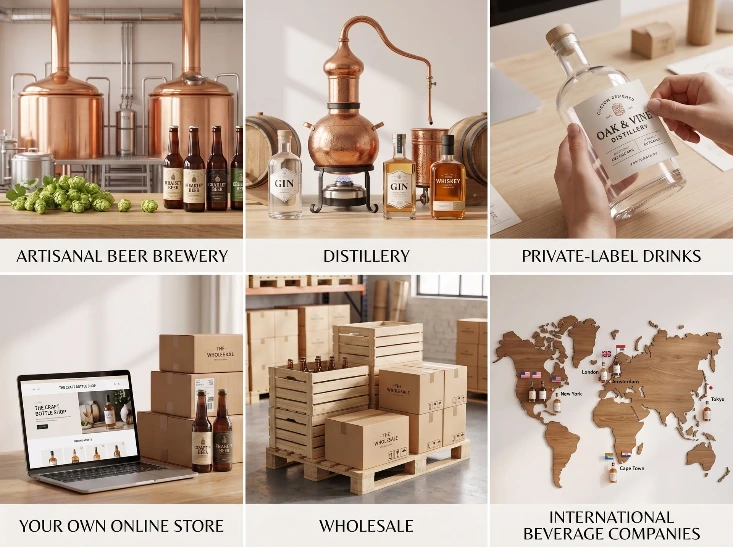
This industry solution is suitable for, among others:
Craft breweries.
Production breweries.
Distilleries.
Producers of gin, rum, whisky, vodka, and liqueurs.
Contract brewers.
Contract distillers.
Producers of private label beverages.
Beverage producers with their own webshops.
Companies with an excise goods location or fiscal warehouse.
Producers with multiple brands.
International beverage companies.
Companies that combine production with wholesale, hospitality, retail, or consumer sales.
The final setup depends on the production process, the scale, the permits, and the countries in which the company operates.
Which companies is this solution suitable for?
This industry solution is suitable for, among others:
Craft breweries.
Production breweries.
Distilleries.
Producers of gin, rum, whisky, vodka, and liqueurs.
Contract brewers.
Contract distillers.
Producers of private label beverages.
Beverage producers with their own webshops.
Companies with an excise goods location or fiscal warehouse.
Producers with multiple brands.
International beverage companies.
Companies that combine production with wholesale, hospitality, retail, or consumer sales.
The final setup depends on the production process, the scale, the permits, and the countries in which the company operates.
Why Newconomie?
We understand both Odoo and the beverage industry
A brewery or distillery gains little from a generic software installation.
The implementation must take into account production, batches, liquid inventory, bottling,
quality registration, excise, and various sales channels.
Newconomie combines Odoo knowledge with practical experience in the beverage sector.
That means:
We start with the actual process.
- We make complex steps understandable.
We think along about production and administration.
We connect the shop floor, warehouse, sales, and accounting.
We take into account B2B, B2C, and private label.
We can structure multiple companies, countries, and websites.
We guide employees during and after the implementation.
We only build what is truly necessary.
- The goal is not to install as much software as possible.
The goal is to make the business more manageable.
Why Newconomie?
We understand both Odoo and the beverage industry.
A brewery or distillery has little use for a generic software installation.
The implementation must take into account production, batches, liquid inventory, bottling,
quality registration, excise duties, and various sales channels.
Newconomie combines Odoo knowledge with practical experience in the beverage sector.
That means:
We start with the actual process.
We make complex steps understandable.
We think along about production and administration.
We connect the shop floor, warehouse, sales, and accounting.
We take into account B2B, B2C, and private label.
We can structure multiple companies, countries, and websites.
We guide employees during and after the implementation.
We only build what is truly necessary.
The goal is not to install as much software as possible. The goal is to make the company more manageable.
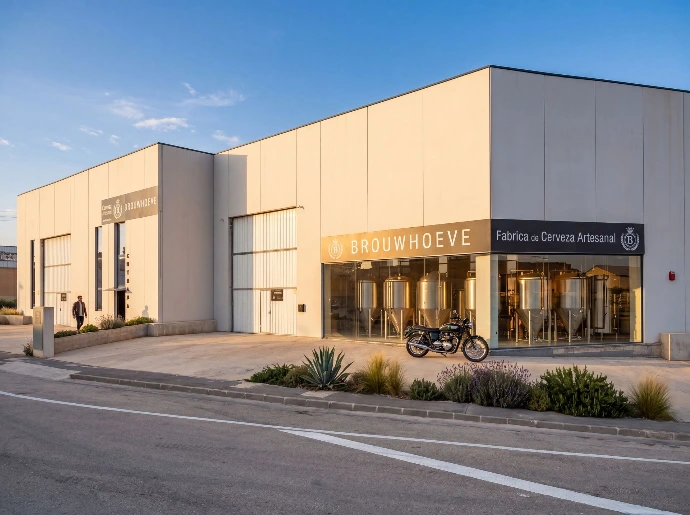
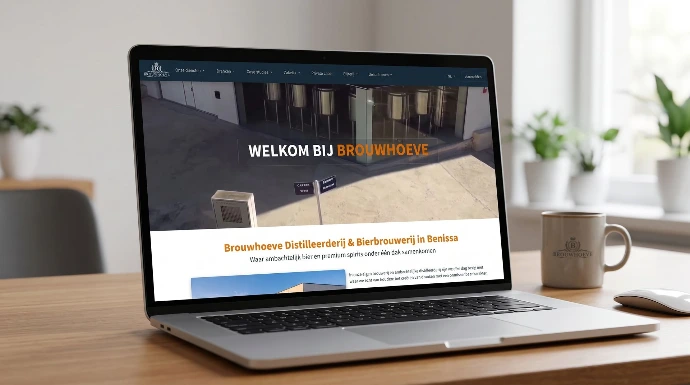
Practical example: Brouwhoeve
Newconomie has set up an extensive Odoo environment for Brouwhoeve where production, inventory,
batch registration, quality, excise, sales, invoicing, and multiple websites come together.
This case shows how a brewery and distillery with multiple companies, countries, products, and
sales channels can operate from one central environment.
The Brouwhoeve case is not a standard package that is copied by every company. Every brewery and
distillery has its own products, processes, permits, and responsibilities.
The experience from this practice is used to build new implementations faster, more realistically, and better
manageable.
Practical example: Brouwhoeve
Newconomie has set up an extensive Odoo environment for Brouwhoeve where production, inventory,
batch registration, quality, excise duties, sales, invoicing, and multiple websites come together.
This case shows how a brewery and distillery with multiple companies, countries, products, and
sales channels can operate from one central environment.
The Brouwhoeve case is not a standard package that is copied by every company. Every brewery and
distillery has its own products, processes, permits, and responsibilities.
The experience from this practice is used to build new implementations faster, more realistically, and better
manageable.
What does a good Odoo implementation yield?
After a well-executed implementation, the following arises:
One central source for production and inventory data.
More control over raw materials, bulk inventory, and finished products.
Better batch and lot number registration.
Demonstrable quality controls.
Structured HACCP or APPCC registrations.
An excise administration that better aligns with the physical inventory.
Less manual input.
Fewer discrepancies between systems.
Current inventory for sales and webshops.
Better production planning.
Insight into cost prices and margins.
Faster information during inspections or deviations.
A scalable basis for further growth.

From craft to manageable business operations
The character of the product remains artisanal.
The surrounding processes become more professional, transparent, and better controllable.
Newconomie helps breweries and distilleries to bring production, quality, excise, inventory, sales, and
administration together in one practical Odoo environment.
What does a good Odoo implementation yield?
After a well-executed implementation, the following arises:
One central source for production and inventory data.
More control over raw materials, bulk inventory, and finished products.
Better batch and lot number registration.
Demonstrable quality controls.
Structured HACCP or APPCC registrations.
An excise administration that better aligns with the physical inventory.
Less manual input.
Fewer discrepancies between systems.
Current inventory for sales and webshops.
Better production planning.
Insight into cost prices and margins.
Faster information during inspections or deviations.
A scalable basis for further growth.
From craft to manageable business operations
The character of the product remains artisanal.
The surrounding processes become more professional, transparent, and better controllable.
Newconomie helps breweries and distilleries to bring production, quality, excise, inventory, sales, and
administration together in one practical Odoo environment.
FAQ
The answers are intentionally compact and self-explanatory. This helps visitors, search engines, and generative search systems to understand specific questions directly.
Odoo can connect production, recipes, raw materials, inventory, batches, quality controls, sales, webshops, delivery, and accounting. This allows the brewery to operate from one central environment instead of various separate systems.
Yes, provided the environment is set up correctly. Production steps such as maceration, distillation, storage, aging, blending, dilution, bottling, and packaging can be translated into production orders, work orders, inventory locations, and batch records.
Yes. Tanks, barrels, IBCs, and other storage locations can be set up as locations, packaging, equipment, or individually managed units. The best method depends on how the company produces, measures, and reports.
Yes. Raw materials, semi-finished products, and finished products can be tracked with lot numbers. This allows for tracing which raw materials were used in a batch and to which customers the finished products were delivered.
Odoo can structure controls, registrations, documents, deviations, and corrective actions. The system can, for example, activate controls during receipt, production, bottling, or delivery. Odoo does not replace the formal HACCP or APPCC plan and the assessment by competent experts or authorities.
No. Odoo is not a replacement for the competent health authority or official procedures. It can help organize the necessary business registrations, controls, documents, and evidence.
Odoo can support the source administration for excise by registering production, inventory, volumes, alcohol percentages, tax locations, and goods movements. The exact setup depends on the permits and national regulations.
Not automatically. EMCS and SILICIE are official systems. Odoo can prepare data, reports, and exports and can be technically linked in certain situations. Feasibility must be examined per country, process, and obligation.
Yes. Inventory locations and goods movements can be set up so that a distinction remains visible between, for example, inventory under excise suspension and excised commercial stock. The setup must align with the permit and administrative procedures of the company.
Yes. The difference between planned and actually used or produced quantities can be recorded. It must be determined how production loss, evaporation, breakage, destruction, and other differences are to be processed administratively.
Yes. A bulk product can be processed into different sales products, such as bottles of 50 cl and 70 cl, gift packaging, boxes, or private-label variants. For each end product, unique barcodes, prices, labels, and packaging materials can be used
Yes. Requests, quotes, recipes, documents, approvals, packaging specifications, production, inventory, delivery, and invoicing can be managed within a single project and production process.
That is possible. Odoo can connect multiple websites and sales channels with the same central product and inventory data. Different prices, products, languages, and access rules can be set for each website.
Yes. Odoo supports multiple websites from the same database. This is useful for different brands, countries, languages, or target groups.
Yes. Different legal entities can be set up within a single Odoo database. Business data, warehouses, taxes, websites, rights, and intercompany processes must be carefully separated.
No. The implementation can take place in phases. A company can, for example, start with sales, inventory, and accounting and then add production, quality, excise, and webshops. The order must be designed in advance so that later expansions align with the foundation.
No. Odoo can also be suitable for smaller and medium-sized producers. It is important that the setup is not made unnecessarily complex. A small brewery usually needs a simpler process than an international producer with multiple locations and brands.
The costs depend on the number of users, companies, warehouses, websites, production processes, migrations, integrations, and necessary adjustments. Newconomie therefore starts with an analysis of the current working method and desired situation.
TOP
Odoo can connect production, recipes, raw materials, inventory, batches, quality controls, sales, webshops, delivery, and accounting. This allows the brewery to operate from one central environment instead of various separate systems.
Yes, provided the environment is set up correctly. Production steps such as maceration, distillation, storage, aging, blending, dilution, bottling, and packaging can be translated into production orders, work orders, inventory locations, and batch records.
Yes. Tanks, barrels, IBCs, and other storage locations can be set up as locations, packaging, equipment, or individually managed units. The best method depends on how the company produces, measures, and reports.
Yes. Raw materials, semi-finished products, and finished products can be tracked with lot numbers. This allows for tracing which raw materials were used in a batch and to which customers the finished products were delivered.
Odoo can structure controls, registrations, documents, deviations, and corrective actions. The system can, for example, activate controls during receipt, production, bottling, or delivery. Odoo does not replace the formal HACCP or APPCC plan and the assessment by competent experts or authorities.
No. Odoo is not a replacement for the competent health authority or official procedures. It can help organize the necessary business registrations, controls, documents, and evidence.
Odoo can support the source administration for excise by registering production, inventory, volumes, alcohol percentages, tax locations, and goods movements. The exact setup depends on the permits and national regulations.
Not automatically. EMCS and SILICIE are official systems. Odoo can prepare data, reports, and exports and can be technically linked in certain situations. Feasibility must be examined per country, process, and obligation.
Yes. Inventory locations and goods movements can be set up so that a distinction remains visible between, for example, inventory under excise suspension and excised commercial stock. The setup must align with the permit and administrative procedures of the company.
Yes. The difference between planned and actually used or produced quantities can be recorded. It must be determined how production loss, evaporation, breakage, destruction, and other differences are to be processed administratively.
Yes. A bulk product can be processed into different sales products, such as bottles of 50 cl and 70 cl, gift packaging, boxes, or private-label variants. For each end product, unique barcodes, prices, labels, and packaging materials can be used
Yes. Requests, quotes, recipes, documents, approvals, packaging specifications, production, inventory, delivery, and invoicing can be managed within a single project and production process.
That is possible. Odoo can connect multiple websites and sales channels with the same central product and inventory data. Different prices, products, languages, and access rules can be set for each website.
Yes. Odoo supports multiple websites from the same database. This is useful for different brands, countries, languages, or target groups.
Yes. Different legal entities can be set up within a single Odoo database. Business data, warehouses, taxes, websites, rights, and intercompany processes must be carefully separated.
No. The implementation can take place in phases. A company can, for example, start with sales, inventory, and accounting and then add production, quality, excise, and webshops. The order must be designed in advance so that later expansions align with the foundation.
No. Odoo can also be suitable for smaller and medium-sized producers. It is important that the setup is not made unnecessarily complex. A small brewery usually needs a simpler process than an international producer with multiple locations and brands.
The costs depend on the number of users, companies, warehouses, websites, production processes, migrations, integrations, and necessary adjustments. Newconomie therefore starts with an analysis of the current working method and desired situation.